Writing the playbook for a smarter, fairer future.
Books and articles on sustainable development, AI and systems thinking, for readers who want more than headlines.
PUBLICATIONS
Books, Articles, Guides, Columns & other Publications
Books & chapters
- Schmidt A. (2021) Health and the City: How Cities Impact on Health, Happiness, and Well-Being. In: Brears R. (eds) The Palgrave Encyclopedia of Urban and Regional Futures. Palgrave Macmillan, Cham.
- Foreword in Weenk, E. and Henzen, R. (2021). Mastering the Circular Economy. "Hands-on Guidance for Future-Proofing your Business".
- Schmidt, A. (2010). “Corporate Social Responsibility in Austria”; Chapter in the ‘World Guide to Corporate Social Responsibility’, edited by W. Visser and N. Tolhurst (2010).
Peer-reviewed articles
- Borgermann, N., Schmidt, A. and Dobbelaere, J. (2022). Preaching water while drinking wine: Why universities must boost climate action now. One Earth Commentary I Volume 5, ISSUE 1, P18-21, 22 January 2022;
- Schmidt, A. and Winkler, C. (2021). Piecing together The Sustainability Puzzle: How an ambitious book was born. One Earth Backstory | Volume 4, ISSUE 10, P1339-1347, 22 October 2021;
- Schmidt, A. (2021). Creating Win-Wins by Taking Drastic Action on Sustainability. The Defence Horizon Journal
- McPake, B., Brikci, N., Cometto, G., Schmidt, A. and Araujo, E. (2011). “Removing user fees: learning from international experience to support the process”; Health Policy and Planning.
- Schmidt, A. (2007). “Volunteer Child Soldiers as Reality: A Development Issue for Africa”; New School Economic Review, Vol 2(1), 2007, 49-76.
- Schmidt, A. (2006). “Explaining Voluntary Recruitment of Children as Soldiers in Sub-Saharan Africa: Navigating between Victimisation and Agency of Children to Facilitate Reintegration and Peace”; Master’s thesis: School of Oriental and African Studies, University of London.
- Schmidt, A. (2001). “Brand Preferences and Brand Knowledge of 3 to 5 year old Children in Australia: An Empirical Survey and Ethical issues in Marketing to Children”; Master’s thesis: Vienna University of Economics and Business.
Institutional publications
- Schmidt, A. (2024). "Wie eine Zukunft mit KI gelingen kann", in facultas Wissen Spezial 2024.
- Gradl, C., Schmidt, A. et al. (2019) "Inclusive Business: Make or Buy? Corporate Impact Venturing at the Base of the Pyramid", Endeva.
- Schmidt, A. et al. (2019). "The Use of ICT Solutions in Inclusive Value Chains", Endeva/Fundes.
- Schmidt, A. (2013). “Mining Health Programs in Papua New Guinea: Lessons Learned to Inform Good Practice”. Mining Health Initiative.
- Schmidt, A. and Woods, N. (2013). “Newmont Ghana’s Akyem Mine: Lessons Learned in Partnership and Process; Mining Health Initiative Case Study”.
- Schmidt, A. and Timmermans, N. (2013). “Rio Tinto (QMM) and its health programme in Madagascar: Lessons Learned in Partnership and Process; Mining Health Initiative Case Study”.
- Schmidt, A. (2013). “Education: Harnessing School-Based Programmes to Improve Health Outcomes”. Oxford Policy Management/Partnership for Maternal, Neonatal and Child Health.
- Schmidt, A. and Mecaskey, J. “Mining Health Partnerships: A short analytic framework”; Mining Health Initiative.
- Schmidt, A. and Mecaskey, J. (2012). “An analysis of what is known about Mining Industry Health Programmes”; Key literature findings update, Mining Health Initiative.
Guides & toolkits
- UNIDO (2015). “Guide on Gender Mainstreaming of Business, Investment and Technology Services for Private Sector Development”.
- Schmidt, A. (2013). “Good Practice Guidelines: Partnering for Effective Mining Health Programming”. Mining Health Initiative.
- Schmidt, A., de Lind van Wijngaarden, J., Bjarnegard, E. (2003). “HIV/AIDS and Education – A Toolkit for Ministries of Education”; UNESCO Bangkok
- Schmidt, A. (2004). Training Module on Stakeholder Analysis; Advocacy Package: Asian Institute for Development Communication/UNFPA.
Commentary
- Kreislaufwirtschaft als Win-win-Situation: KI kann dabei helfen | Der Standard/Mediaplanet, 2023
- Ohne ein gewisses ‘Gspür’ für Nachhaltigkeit, warden wir nicht überleben | Horizont, 2022
- Nachhaltigkeit ist eine Wettbewerbsvorteil! | Nachhaltigkeit, 2022
- Geht Ihre Badenwanne nicht trotzdem über? | Oliv Begegnung, 2022
- Schmidt, A. and Winkler, C. (2021). Sechs Puzzlesteine auf dem Weg zu Gesundheit, Gerechtigkeit und Wohlstand für alle. Brutkasten #12/2021
- Schmidt, A. (2020). 50 Opportunities for a Better World. B4 Magazine, issue 62, June 2020, pp. 52 - 55
- Schmidt, A. (2013). “Glück und Politik: Wie uns die Politik (nicht) glücklich machen kann - Das BIP und seine Alternativen zur Messung von gesellschaftlichem Wohlbefinden und Fortschritt”; Happiness Observer 4-6/2013.
- Article on Politics & Happiness in the Happiness Observer
Monthly Columns
PUBLICATIONS
Books worth reading
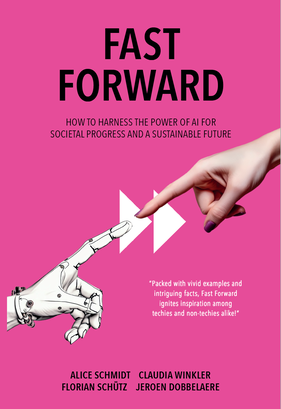
Fast Forward
We’re at a watershed moment for sustainable transformation — and technology, especially AI, could be pivotal. Yet a persistent gap between the sustainability and tech sectors is creating inefficiencies, missed opportunities and growing risks for people and planet. Closing that gap is key to a sustainable future.
Written by sustainability specialist Alice Schmidt, entrepreneur Claudia Winkler, AI expert Florian Schuetz and life scientist Jeroen Dobbelaere, Fast Forward bridges sustainability and technology, tackling the questions raised since ChatGPT’s release. Drawing on real-life examples, the authors make the case for ethical, responsible AI as the key to harnessing its power for health, wealth and wellbeing.
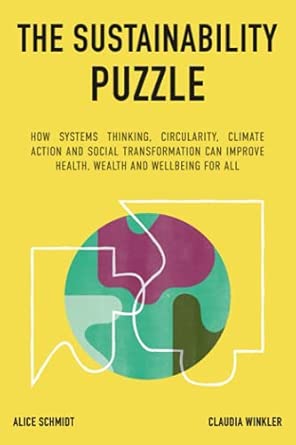
The Sustainable Puzzle
We’ve reached a turning point: the stakes are high, but we already have the tools to build a better, more sustainable and inclusive future. The key is to zoom out before we zoom in — to look at the whole picture instead of working in silos, and to tackle social, economic and environmental issues together.
Alice Schmidt and Claudia Winkler are pragmatic thinkers and doers, drawing on 40+ years of combined experience in social justice, climate action, the circular economy, technology and sustainable business. The Sustainability Puzzle makes the case for optimism — and offers constructive insight into building back better.